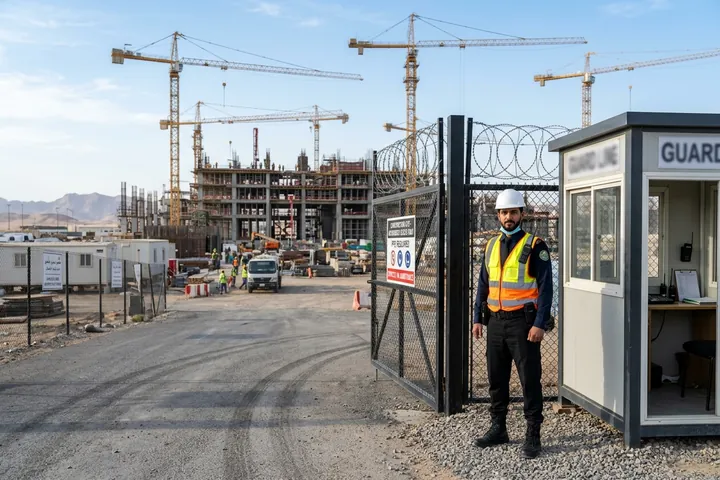
Security Guards for Construction Sites and Development Projects
Saudi guard teams for your site from mobilisation to handover: gate control, material passes and night patrols, with headcount that follows your project phases. Licensed by SAIS (licence 2611000012, Category One).
Who sets guarding on a construction site, and the rules that apply
Article 2 of the executive regulation of the Private Civil Security Guarding Law, as amended and published in Umm Al-Qura on 16 May 2025, lists the sites that must have guards, such as hotels, hospitals, malls, towers, factories and warehouses. Construction sites are not among its categories. On most projects, guarding is therefore set by the contract, the insurer or the owner's HSE requirements, and the main contractor carries it into the guarding subcontract.
The Balady guide to fencing construction sites sets the requirements for site fences and gates. The fence and gates are where a guarding plan starts: fixed posts at the gates, patrols along the fence line, and closer attention to the stretches that are not yet complete.
MHRSD work-environment rules for the guarding sector (19 October 2022) treat "facilities under construction and far from urban areas" as a separate guard work environment, alongside indoor and outdoor posts, and say a guard may not work 5 continuous hours without a break of at least 30 minutes. The midday outdoor-work ban, 12:00 to 15:00 from 15 June to 15 September, applied again in 2026, so we plan outdoor posts in summer with shade and rotation.
On any site, the guarding company must be licensed and all its staff Saudi. Halcones holds SAIS licence 2611000012, Category One, valid to 28 April 2027, and a copy goes into the prequalification pack your main contractor asks for.
The pressures facing construction site security today
01
Material and equipment theft
Cable, copper, fittings, tools and diesel are typical theft targets on construction sites. The finishing phase brings far more material on site, and with it more exposure, and the shortage is often found days later when work stalls for a material that is no longer there.
02
Uncontrolled entry of workers and subcontractors
One project can have many subcontractors, each with workers, drivers and suppliers coming through the same gate. As crews change from week to week, badges get shared, permits expire unnoticed, and it is hard to say who is on site at any moment.
03
An incomplete fence at night and at weekends
In some phases the fence is partial or temporary, and laydown yards, site offices and heavy equipment sit still after work ends. In those hours, from night through the weekend, the fence and the patrols are all that protect the site.
04
Remote sites and summer heat
Many projects sit far from the city, so guards need regular transport, a place to rest, water and shade. Gate posts run outdoors all summer and breaks must be covered, so any gap in these arrangements shows up quickly in post discipline.
05
Headcount that changes with each phase
Enabling works need few posts; numbers rise through structure and finishing, then fall at handover. The main contractor wants a complete prequalification file before contract and a provider that starts on time and scales with the project without renegotiating at every phase.
Solutions
How our guards answer each pressure
Main gate and worker access
Gate guards check worker badges and subcontractor permits and their expiry, register visitors and suppliers, and keep an up-to-date list of who is on site, working with your HSE lead. The gate can also confirm that a worker has completed the safety induction before entry.
Material-out passes and delivery checks
Guards match every outbound vehicle to its material-out pass and every inbound delivery to its delivery note, and record plate, driver and time in the gate register. Material without a valid pass is held at the gate and reported to your designated contact.
Night and weekend patrols
Scheduled and random patrols, on foot or with patrol vehicles and golf carts on larger sites, cover the fence line, laydown yards, site offices and equipment. Every patrol is logged with times and findings, and fence gaps or lighting faults are reported within the same shift.
A guarding plan that follows your phases
We agree a post plan for each phase with you: fewer posts during enabling works, more through structure and finishing when material builds up, then a step-down at handover. The plan is updated at the monthly review, so headcount changes with your project under the same contract.
Remote-site and summer readiness
We arrange guard transport to remote sites, mark the outdoor posts that need shade and cooling during the survey, and plan rotation and breaks through the hottest hours in line with the work-environment rules for remote areas. A shaded guard cabin is usually part of the site set-up, and we agree it with you at the survey.
Prequalification and working as a subcontractor
We work as a subcontractor to the main contractor, or under the developer's security team on large projects, to their instructions and procedures. We provide the prequalification file you ask for, including a copy of our SAIS licence, so registration is complete before the start date.
How we operate
How we deploy and manage your site
Site survey and mobilisation
We walk the gates, fence and laydown yards with your project manager or HSE lead, agree post orders and the pass procedure, then mobilise on the agreed start date with every guard briefed on your site safety rules.
A supervisor on every shift
Each shift has a named supervisor who checks posts, follows the night patrols, handles escalation and is your direct contact for the whole shift.
Daily logs and gate registers
Every post keeps a daily occurrence log, and gates keep registers of workers, vehicles, passes and outbound material. Incidents are reported to your contact within the same shift.
Relief guards for breaks
MHRSD work-environment rules say a guard may not work 5 continuous hours without a break of at least 30 minutes, with a substitute covering the post. We build that relief into the roster, so the gate stays staffed through every break, which matters even more on remote sites.
Replacement when a guard is absent
If a guard is absent, the shift supervisor brings in a replacement from the team assigned to your project, so the post stays covered and you receive the headcount in your contract.
Phase reviews and headcount changes
Each month we review logs, incidents and headcount with you and match the post plan to the next phase, adding guards before finishing and stepping down near handover, on the notice your contract sets.
What happens after you send your request?
We contact you within 15 minutes to confirm your needs
A site visit when needed
A detailed quote based on your posts and shifts
Service starts on the agreed date
Frequently asked questions
FAQ
01How is the price of construction site guarding calculated?+
Price follows posts × hours × shifts, plus supervisors, any patrol vehicle and guard transport to remote sites. Under the labour law a guard works 48 hours a week (36 in Ramadan for Muslims) and one shift a day, so a post staffed 24/7 needs about 3.5 guards on paper (168 ÷ 48) and, in practice, around 4 to 4.5 once leave and absence relief are counted.
02Is a construction site legally required to have guards?+
Construction sites are not among the categories of sites that must have guards in Article 2 of the executive regulation. On most projects guarding is set by the contract with the owner, insurance requirements or HSE requirements. The guarding company itself must be licensed, with all staff Saudi, on any site.
03What contract terms are available?+
Monthly or annual. A monthly contract suits a short project or a single phase; an annual contract suits a project that runs longer than a year. Headcount is adjusted for each phase under the same contract.
04Can you increase or reduce guards as the project moves through phases?+
Yes. We agree a post plan for each phase and review it monthly, adding posts through structure and finishing and reducing them near handover. Our Category One licence allows a guard force of up to 1,000 guards.
05How do your guards deal with material theft?+
Control starts at the gate: nothing leaves without a valid pass, and every delivery is checked against its delivery note. Night patrols then cover laydown yards and the fence line, and any shortage or gap is reported within the same shift, so you keep a clear record to refer back to.
06Do you work on remote sites far from cities?+
Yes. We cover all 13 regions from our office in Al Olaya, Riyadh, including Tabuk, Makkah, the Eastern Province and Asir. On remote sites we arrange guard transport and plan shifts and breaks in line with the work-environment rules for remote areas.
07How do you handle summer heat on outdoor posts?+
During the survey we mark the posts that need shade and cooling, and we plan rotation and breaks through the hottest hours, taking into account the midday outdoor-work ban from 12:00 to 15:00 between 15 June and 15 September.
08Who provides the guard cabin on site?+
The guard cabin is usually part of the site set-up, as in government guarding contracts, where guard rooms are procured separately from the guarding service. We agree its location, shade and cooling with you at the survey.
09Do you work as a subcontractor to the main contractor or the developer?+
Yes. We work as a subcontractor to the main contractor, or under the developer's security team, to their instructions and the site's HSE procedures, and we provide the prequalification file they ask for, including a copy of our licence.
10Can we switch from our current provider without a gap in cover?+
Yes. We plan the changeover around your current contract's end date: we survey the site, agree post orders, brief the guards on the site and its safety rules, and take over the gate registers on the agreed day, so every post is staffed as the outgoing team leaves.
11Do guards supplied by a guarding company count toward the contractor's Saudisation?+
100% of our guards are Saudi. Saudi guards contracted through a guarding company can count toward your Nitaqat ratio under the programme's conditions; we explain this in the proposal.
12How quickly do you respond to a quote request?+
We get back to you within 15 minutes of your request. Then we survey the site with your project manager, send a priced post plan for each phase and mobilise on the agreed date.
Tell us where your project is, which phase it is in and how many gates it has. We get back to you within 15 minutes, survey the site and send a post plan for each phase with a firm price, on a monthly or annual contract. Or email info@halcones.sa.