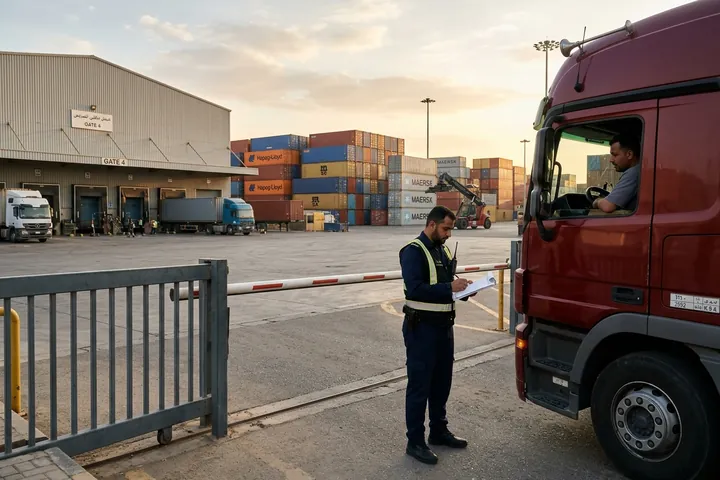
Security Guards for Warehouses, Logistics Parks and Container Yards
Saudi guard teams that control your truck gates, loading docks and yard perimeter on every shift, licensed by SAIS (licence 2611000012, Category One) and ready to add posts when volumes peak.
When a warehouse must have guards, and what falls on the operator
The executive regulation of the Private Civil Security Guarding Law (Article 2, as amended and published in Umm Al-Qura on 16 May 2025) lists factories and warehouses among the sites that must have 24-hour guarding when the regional police director orders it, following a feasibility study by a licensed security consultancy. The study must be submitted within two months of notification. For many warehouses and distribution centres, that order is the point where guarding moves from plan to contract.
The Security Surveillance Cameras Law (Royal Decree M/34, 2022) names commercial warehouses among the sites that must install cameras, with penalties for each violation. Under a SAIS decision announced in May 2019, entities that contract guarding companies must equip their facilities with cameras to the approved specifications, and a guarding contract is signed or renewed once that is in place. We check your camera readiness with you before the contract, because it protects your contract and your site.
Ports are one of the sectors SAIS supervises, so facilities inside or next to a port may fall under SAIS requirements. This varies from site to site, so we confirm it with you during the survey. On bonded and port-side sites, our guards work to the passes, access rules and site induction that apply there.
The law requires every guarding company's staff to be Saudi, and Article 3 adds that an entity employing more than 20 guards directly must set up its own security department. Many logistics operators therefore keep an in-house security or loss-prevention lead and contract the guard force: your lead sets the procedure, our teams apply it at every gate on every shift.
The pressures facing warehouse and logistics security today
01
Loads that leave without a check
Much of a warehouse's loss leaves on a truck: an extra pallet on an outbound load, a container whose seal number does not match its papers, a delivery that arrives short and nobody notices. When trucks pass the gate on the driver's word, the gate register stops working as a control.
02
Truck queues at the gate
Trucks bunch up at shift start and at receiving windows, and drivers wait at the gate and the weighbridge, which puts pressure on the guard to wave them through. With driver rest areas, visitors and contractors on the same site, keeping both the entry order and an accurate register gets hard.
03
Loading docks and high-value cages
Docks stay open for long hours and many hands pass through them: loaders, drivers and warehouse staff. High-value cages, reefer areas and warehouse keys need clear control of who enters and who signs, or they turn into loss points that are hard to trace.
04
The yard perimeter after dark
Container stacks and parked trailers create corners the gate cannot see, large yards have long fence lines, and parts of them go dark after work stops. Fence gaps and stretches patrols rarely reach are where intrusion and theft begin.
05
Peak seasons and several sites
Volumes change from week to week, and a warehouse may need an extra gate or a night shift in the seasons you set. Many logistics providers run sites in more than one city; when guarding standards differ between sites, it becomes hard to compare registers and to keep track of camera and work-environment requirements on outdoor posts through the summer.
Solutions
How our guards answer each pressure
A clear truck-gate procedure
At every truck, guards follow the same steps: check the driver's ID and gate pass, match the container and seal numbers to the documents, record it in the gate register, then release. A truck whose papers do not match is held at the gate and reported to your designated contact.
Queue order and driver areas
Guards bring trucks in the order you set, direct drivers to the assigned waiting and rest area, and control visitor and contractor movement, so the gate stays orderly and the register accurate even at peak hours.
Dock supervision and outbound checks
A dock post watches loading and unloading, checks outbound loads against delivery notes as your procedure defines, and controls access to high-value cages and reefer areas, with a key log signed at every shift change.
Perimeter and yard patrols
Scheduled and random patrols, on foot or with patrol vehicles and golf carts on large yards, cover the fence line, container rows and trailer parking. Every patrol is logged with times and findings, and fence damage, lighting faults or open gates are reported within the same shift.
Control-room monitoring and bonded sites
Where your site already has a camera system, our guards can staff your control room, dispatch patrols to alarms and keep the occurrence log. On bonded and port-side sites, guards work to the access passes, site induction and procedures that apply there.
Peak-season posts and one standard across sites
We add temporary posts on gates and docks for the seasons you set, under supervisors who already know your site. If you run sites in several cities, each one works to the same procedure and the same registers, so the reports you receive are easy to compare.
How we operate
How we deploy and manage your site
Site survey and mobilisation
We walk your gates, docks and perimeter with your lead, agree the gate procedure and written post orders, mark the outdoor posts that need shade and rotation in summer, then mobilise on the agreed start date with every guard briefed on your site.
A supervisor on every shift
Each shift has a named supervisor who checks gates and docks, makes sure the gate procedure is followed, handles escalation and is your direct contact for the whole shift.
Daily logs and gate registers
Every post keeps a daily occurrence log, and truck gates keep registers of vehicles, drivers, seals and passes. Incidents are reported to your contact within the same shift.
Relief guards for breaks
MHRSD work-environment rules for the guarding sector say a guard may not work 5 continuous hours without a break of at least 30 minutes, with a substitute covering the post. We build that relief into the roster, so the truck gate stays staffed through every break.
Replacement when a guard is absent
If a guard is absent, the shift supervisor brings in a replacement from the team assigned to your site, so the post stays covered and you receive the headcount in your contract.
Monthly review and peak planning
Each month we review gate registers, incidents, findings and headcount for every site with you, update post orders, and plan extra posts for the coming peaks in advance.
What happens after you send your request?
We contact you within 15 minutes to confirm your needs
A site visit when needed
A detailed quote based on your posts and shifts
Service starts on the agreed date
Frequently asked questions
FAQ
01How is the price of warehouse guarding calculated?+
Price follows posts × hours × shifts, plus supervisors, any patrol vehicle and seasonal posts. Under the labour law a guard works 48 hours a week (36 in Ramadan for Muslims) and one shift a day, so a gate staffed 24/7 needs about 3.5 guards on paper (168 ÷ 48) and, in practice, around 4 to 4.5 once leave and absence relief are counted. So the number of 24/7 truck gates drives your quote more than anything else.
02What contract terms are available?+
Monthly, annual or seasonal. An annual contract suits permanent gate and dock posts; a monthly contract suits a new site or a trial period. Peak-season posts are added to your contract for the weeks you need them.
03Are warehouses legally required to have guards?+
The amended Article 2 of the executive regulation covers factories and warehouses: 24-hour guarding becomes mandatory when the regional police director orders it after a feasibility study by a licensed consultancy, submitted within two months of notification. Many warehouses contract guarding before that point to protect stock and equipment.
04Do cameras need to be in place before a guarding contract?+
The Security Surveillance Cameras Law names commercial warehouses among the sites that must install cameras, and under the 2019 SAIS decision a guarding contract is signed or renewed once the facility has cameras to the approved specifications. We review this with you during the survey; installing the system stays with your systems contractor.
05Can we switch from our current provider without a gap in cover?+
Yes. We plan the changeover around your current contract's end date: we survey the site, agree the gate procedure and post orders, brief the guards and take over the gate registers on the agreed day, so every post is staffed as the outgoing team leaves.
06How do your guards handle container seals and shipping documents?+
Guards match the container and seal numbers to the documents travelling with the truck, record plate, driver and time in the gate register, and hold any truck whose papers do not match for your authorised approver. You set the procedure and the sign-off; we apply it to every truck.
07Do you work on bonded warehouses and port-side sites?+
Yes. Halcones holds SAIS private civil guarding licence 2611000012, Category One, valid to 28 April 2027. On these sites our guards work to the access passes and site induction, and to the procedures you or the zone operator set. A copy of the licence comes with every proposal.
08Can you add guards for peak seasons?+
Yes. Share the dates and the extra posts you expect as early as you can. We add guards on gates and docks for the peak, led by the supervisors already assigned to your site, then return to the permanent roster. Our Category One licence allows a guard force of up to 1,000 guards.
09We have warehouses in several cities. Can you cover them all?+
We cover all 13 regions from our office in Al Olaya, Riyadh, including Dammam, Jubail, Jeddah, Madinah and Qassim. One contract can cover all your sites, with one procedure, matching registers and a monthly review for each site.
10Do you provide female guards for female staff areas?+
Yes. Female guards are available in all cities, including night shifts and around the clock. They can staff female staff entrances and areas and handle bag checks for female visitors at distribution centres, under the same contract and supervision as your other posts.
11Do guards supplied by a guarding company count toward our Saudisation?+
100% of our guards are Saudi. Saudi guards contracted through a guarding company can count toward your Nitaqat ratio under the programme's conditions; we explain this in the proposal.
12How quickly do you respond to a quote request?+
We get back to you within 15 minutes of your request. Then we survey the site with your lead, send a priced post plan and mobilise on the agreed date.
A controlled gate and a watched dock on every shift
Tell us about your facility, your truck gates and your peak seasons. We get back to you within 15 minutes, survey the site and send a clear post plan with a firm price, on a monthly, annual or seasonal contract, in any region of the Kingdom. Or email info@halcones.sa.